Guide
Aluminum vs Wood vs Vinyl Pergola: The Materials Breakdown

The Twenty-Year View
Sticker price ranks these materials in one order. Cost of ownership ranks them in a different one, and for a structure with a two-decade design life the second ordering is the one that matters.
| Aluminum | Wood (cedar / redwood) | Vinyl / PVC | |
|---|---|---|---|
| Up-front cost | Highest | Moderate | Low to moderate |
| Maintenance | Rinse annually | Sand + seal every 2–3 yrs | Wash annually |
| Lifespan | 20–30+ yrs | 10–20 yrs with upkeep | 15–25 yrs, cosmetically less |
| Can motorize louvers | Yes | Rarely, poorly | No |
| Span capability | Excellent | Good, with heavy sections | Poor — needs more posts |
| Behaviour in UV | Powder coat fades slowly | Greys without sealing | Can yellow and embrittle |
| Rot / insect risk | None | Real, at ground contact | None |
| Look | Architectural, cool | Warm, natural | Reads as plastic up close |
Aluminum
The reason this whole product category exists. Extruded 6063-T5 or T6 aluminum is dimensionally stable across temperature swings, does not rot, does not host insects, and carries a baked powder-coat finish that outlasts any paint you can apply to timber.
Critically, it is the only one of the three stiff enough and precise enough to support a motorized louver bank. Rotating slats need consistent tolerances at every pivot across a 16-foot span, held for twenty years, through freeze-thaw cycling. Wood moves seasonally. Vinyl creeps under load. Aluminum does neither.
The honest downside: it is the most expensive to buy, and in a traditional or cottage-style garden it can read as cold. Wood-grain powder coats exist and are better than they used to be, but from three feet away nobody is fooled.
Wood
Cedar and redwood are genuinely good pergola materials, and the aluminum industry is unfair to them. They look better in most garden settings, they are cheaper to buy, and a well-detailed cedar pergola with standoffs at every ground contact will last fifteen to twenty years.
The cost is time. Sanding and re-sealing every two to three years is not optional if you want it to keep looking like the day it went up — and an unsealed cedar pergola greys within a season and starts checking within three. Over twenty years that is seven or eight refinishing cycles. Priced at anyone’s hourly rate, the “cheaper” material is not.
Choose wood if: you want fixed dappled shade rather than adjustable louvers, the aesthetic matters more than the maintenance, and you will genuinely do the upkeep.
Side by side
| Model | Price from | Roof | Wind rating | |
|---|---|---|---|---|
| EROMMY 12×16 Motorized Louvered PergolaEROMMY | $6,599.99 | Motorised louvers | Not published | Check price |
| Hansø Horizon Smart PergolaHansø Home | $4,867 | Motorised louvers | 165 mph | Check price |
| EROMMY 12×24 Adjustable Louvered PergolaEROMMY | $2,499.99 | Manual louvers | Not published | Check price |
We earn a commission if you buy through these links. It never changes your price.
Vinyl and PVC
Vinyl solves the maintenance problem and introduces two others. Structurally it is the weakest of the three, so spans need more posts and heavier sections to achieve the same coverage — which eats into the price advantage. And it ages badly in high-UV climates: white vinyl yellows, and the material becomes progressively more brittle, so an impact that would dent aluminum cracks vinyl.
It also cannot support motorized louvers at all, which removes it from consideration for anyone reading this site for its actual subject.
Choose vinyl if: the structure is small, fixed, in a low-UV climate, and up-front cost dominates every other consideration.
What About Steel?
Rare in residential pergolas and worth knowing why. Steel is stronger than aluminum per section, but it is far heavier — which makes shipping and DIY assembly harder — and it rusts wherever the coating is breached. On a structure that lives outdoors and gets drilled during installation, that is a meaningful long-term liability. Commercial installations use it; residential kits almost never do.
Which louvered pergola actually fits your yard?
Four questions. We match you against every model we track and show the closest fit — with the real price.
1 What is your realistic budget?
2 Motorised or manual louvers?
3 How big is the space?
4 What is the weather where you live?
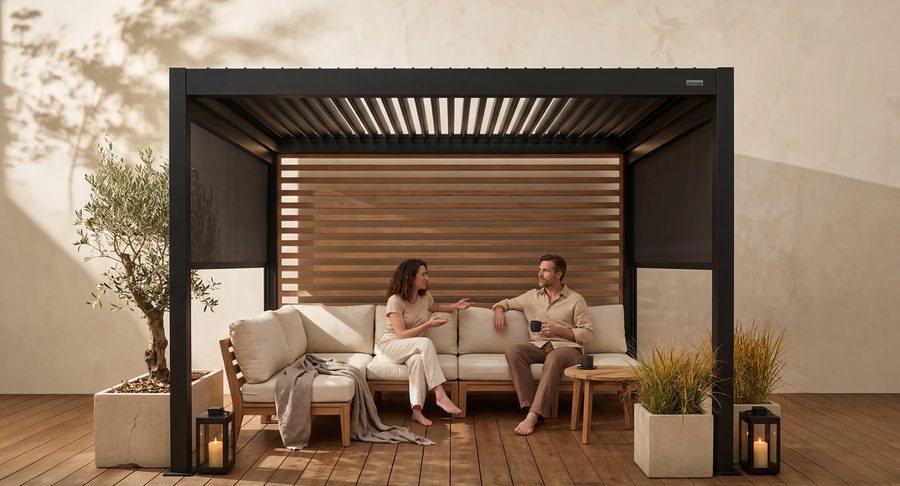 Best Manual Kit
Hansø Aluminum Pergola Kit
Hand-crank louvers, 120 mph rating, no motor to ever fail.
- Wind rating120 mph — Cat 3, independently certified
- Snow load25 PSF
- Frame6063-T5 aluminium, TitanCore bracing
- LouversWindLock mounting, 65% less rattle
- Coating3-layer powder coat, 3× industry thickness
- Nothing electrical to fail in year eight
- Strongest wind rating in the manual category
- Cheapest route into a real louvered roof from this brand
We earn a commission if you buy through these links. It never changes your price.
Affiliate disclosure: We may earn a commission when you buy through links on this site, at no extra cost to you. We only link to products inside the category we research here, and a commission never changes where a product places in our rankings. Full disclosure