Motorized Louvers
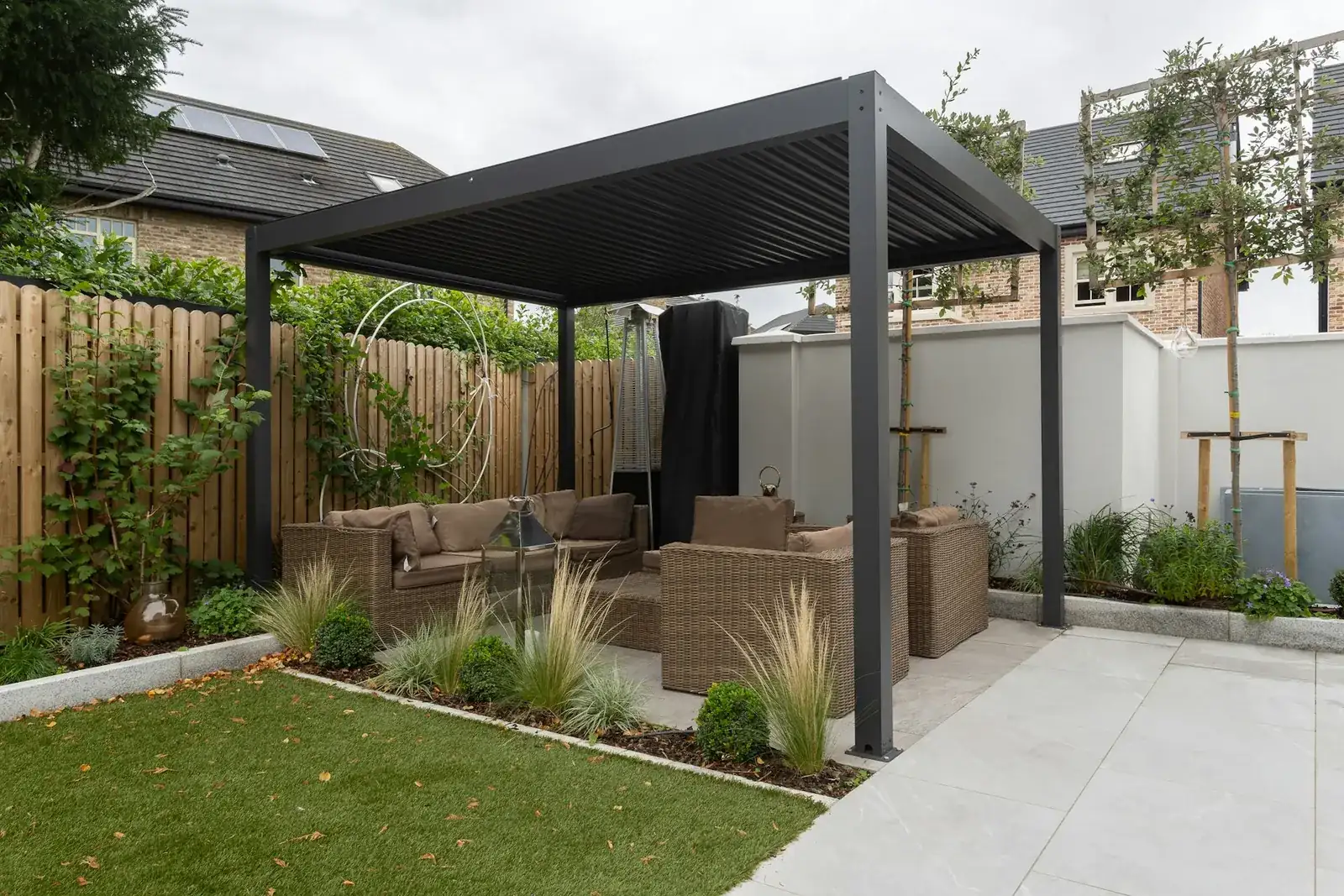
Solid aluminum slats rotate roughly 0–170° from a wall switch, handheld remote or phone app. No ladder, no crank arm.
2026 Buyer's Guide · Independently Researched
Motorized aluminum slats that open for sun, close for rain and lock down for weather — with no ledger board bolted to your house. Here is what actually separates a frame that lasts twenty years from one that rattles apart in three.
Under the Slats
The whole category exists because wood pergolas warp, rot and need refinishing every second summer. Aluminum framing solves that — but only if it is built to spec. Three numbers tell you almost everything.
60-Second Match Finder
Five questions on footprint, climate, budget and who is holding the drill. No email, no signup — the result appears on this page.
Question 1 of 5
Your Match
Why Homeowners Switch
A fixed-roof pergola makes one decision for you, permanently. A retractable fabric canopy adds flexibility but introduces a consumable — fabric fades, tears and gets replaced roughly every seven to ten years. An automatic louvered pergola splits the difference: solid aluminum slats that rotate open for full sun, angle for filtered light, or seal shut in seconds when a storm arrives, with nothing to replace on a cycle.
Because the good ones are genuinely freestanding, they also skip the step that kills most pergola projects: tying a ledger board into your fascia, flashing it correctly, and hoping it never leaks into your siding. Four footings and it is a self-supporting structure anywhere in the yard.
See the full comparison against canopies, awnings and solid covers →
What to Expect
Solid aluminum slats rotate roughly 0–170° from a wall switch, handheld remote or phone app. No ladder, no crank arm.
Four independent posts and footings. Nothing bolted to your house, so it can sit anywhere a patio, deck or paver pad exists.
A baked polyester finish over extruded aluminum resists chipping, salt air and UV fade far longer than any painted timber.
Premium units close the moment a sensor detects rainfall — the feature that matters most on the days you are not home.
Gutter channels inside the frame route water down through the posts instead of sheeting off the edge onto your guests.
Integrated LED lighting, infrared heaters, retractable screens or sliding glass panels for genuine shoulder-season use.
Try It
The same aluminum frame, fully open for airflow and light, then rotated shut for shade and weather. This is the entire argument for the category in one toggle.


Most motors complete the full rotation in under 60 seconds — fast enough to close before a sudden downpour reaches the table.
Shortlist
Three configurations cover the majority of real backyards. The full six-way comparison, with alloy grades, wind ratings and motor warranties, is on the picks page.

A four-to-six seat dining footprint on a standard suburban patio.
$3,200 – $5,500
Read the breakdown →
A full outdoor dining set plus a lounge zone, in a normal wind region.
$5,200 – $8,400
Read the breakdown →
Outdoor kitchens, pool decks, and anything you intend to heat in October.
$7,500 – $12,000
Read the breakdown →Before You Buy
Tick each one off against the listing you are looking at. If you cannot answer it from the product page, that is the question to send the seller.
0 of 7 verified
All seven verified. That is a spec sheet worth buying from — go and confirm current pricing and stock.
Check Current PriceRating Check
Minimum rating to shop for
90–110 mph
A standard 6063-T5 frame is genuinely enough here. Spend the difference on span or a longer motor warranty instead of chasing a rating you will never load.
Go Deeper


Common Questions
Usually yes. Most jurisdictions trigger a permit on footprint, height, permanent footings, or any fixed electrical run — and a motorized pergola normally hits at least two of those. Check your local code before you order, and confirm the manufacturer can supply a wind-load engineering letter, because a permit office that asks for one will not accept a marketing brochure instead.
It depends entirely on the published engineering rating, not the material. Residential aluminum louvered pergolas commonly rate between 90 and 165 mph, and manufacturers specify whether louvers should be closed and locked or rotated open during a storm. For snow, the correct move on most systems is to open the louvers so accumulation falls through instead of loading a flat slat roof.
A small moisture sensor wired to the control unit signals the motor to rotate the louvers closed the moment it detects rainfall, whether or not anyone is home. It is not standard equipment on every model — on mid-tier units it is frequently an add-on module, so confirm it is included rather than assuming.
Freestanding kits are meaningfully more DIY-friendly than wall-mounted ones because there is no ledger board to flash into your siding. That said, squaring a structure this size, setting or bolting four footings, and wiring a motor is a two-person, full-day job at minimum. A common split is DIY frame assembly plus a licensed electrician for the final hookup.
Most systems include either a manual override crank or a battery-backed remote, but this varies by brand and is one of the least advertised specs in the category. If you live somewhere that loses power in the same storms that make you want the louvers closed, treat manual override as a requirement rather than a nice-to-have.
Entry-level 10×10 kits start around $2,000–$3,500. Mid-size motorized units commonly land between $3,500 and $6,500. Large-format or fully-loaded builds with heaters, lighting and screens run $7,000–$12,000 and up. Installation, footings and electrical are usually quoted separately.
A retractable canopy slides a fabric cover along a track. A louvered pergola rotates solid aluminum slats on a hinge, typically through about 0–170 degrees. That gives finer control over light and airflow, and it removes the consumable part — there is no fabric to fade, tear or replace on a roughly seven-to-ten-year cycle.
Six configurations, ranked on the specs that decide whether it is still working in year ten.
See the Full ComparisonAffiliate Disclosure: We may earn a commission when you buy through links on this site, at no extra cost to you. We only link to products inside the category we research here, and a commission never changes where a product places in our rankings.
