Guide
Louvered Pergola Permits: What Most Homeowners Get Wrong

The Misconception
The word “freestanding” does a lot of damage here. Homeowners reasonably assume that a structure not attached to the house is a piece of garden furniture rather than construction. Building departments do not see it that way, and they are not being obstructive: a 200-square-foot roof anchored to concrete footings, generating uplift in a storm, wired to mains power, is a structure.
The Four Triggers
Any one of these usually requires a permit. A motorized louvered pergola typically hits two or three.
- Footprint. Many jurisdictions exempt accessory structures under a threshold — commonly 100, 120 or 200 square feet. Anything above the local number is permitted work.
- Permanent foundation. Poured footings or anchors into a slab make it permanent. This trigger frequently applies regardless of size, which is why a 10×10 unit can still need a permit.
- Electrical. A fixed circuit for motors or lighting is nearly always permitted work, and often requires a licensed electrician of record.
- Height and setback. Most codes cap accessory structure height and require a minimum distance from property lines. Both are worth checking against your site plan before ordering a footprint.
The Document That Actually Causes Problems
The permit application itself is usually routine. What stops projects is the engineering letter — a stamped calculation, signed by a licensed engineer, showing the structure meets the local design wind speed and snow load with the specified footings.
Established manufacturers keep these on file for common jurisdictions and will email one on request. Some importers cannot produce one at all. If your county requires it and your supplier cannot supply it, your options are paying a local engineer several hundred dollars to produce one, or returning a freight-shipped structure at your own cost.
This is a five-minute question to ask before ordering and a very expensive one to ask afterwards.
Side by side
| Model | Price from | Roof | Wind rating | |
|---|---|---|---|---|
| EROMMY 12×16 Motorized Louvered PergolaEROMMY | $6,599.99 | Motorised louvers | Not published | Check price |
| Hansø Horizon Smart PergolaHansø Home | $4,867 | Motorised louvers | 165 mph | Check price |
| EROMMY 12×24 Adjustable Louvered PergolaEROMMY | $2,499.99 | Manual louvers | Not published | Check price |
We earn a commission if you buy through these links. It never changes your price.
What to Ask, Verbatim
To your building department:
- “I’m planning a freestanding aluminum pergola, roughly [size] feet, about [height] feet tall, with a motorized roof on a fixed electrical circuit. Does that need a permit?”
- “Do you require a stamped engineering letter or wind-load calculation, and in what format?”
- “What is the design wind speed and ground snow load for my address?”
- “What is the frost depth for footings here?”
- “What are the setback and height limits for accessory structures on my lot?”
- “Does the electrical need to be done by a licensed contractor of record?”
To the manufacturer, before ordering:
- “Can you supply a stamped engineering letter for [your county]?”
- “What footing detail does your wind rating assume?”
- “Does your wind rating apply with louvers open or closed?”
- “What is your published snow load in psf?”
Building Without a Permit
It happens, and it is worth being clear about the actual consequences rather than moralising about it.
- At sale. Unpermitted structures show up in inspection and title work. Buyers ask for retroactive permitting or a price reduction, and retroactive permitting on a completed structure means exposing footings you already backfilled.
- At claim. If the structure fails in a storm and damages something, an insurer asking whether it was permitted is asking a question with only one good answer.
- At enforcement. A neighbour complaint can result in a stop-work order or a removal order on a structure that is already standing and already paid for.
The permit is typically a modest fee and a form. The exposure without it is not proportionate to what it saves.
Which louvered pergola actually fits your yard?
Four questions. We match you against every model we track and show the closest fit — with the real price.
1 What is your realistic budget?
2 Motorised or manual louvers?
3 How big is the space?
4 What is the weather where you live?
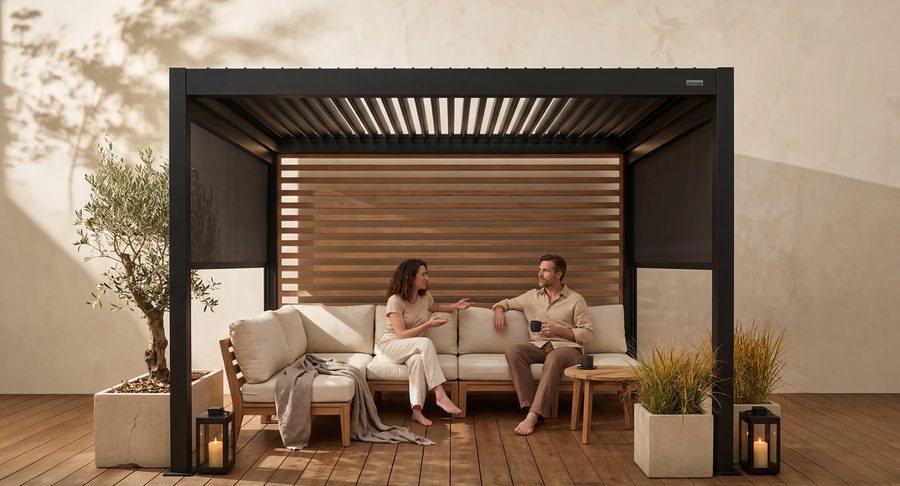 Best Manual Kit
Hansø Aluminum Pergola Kit
Hand-crank louvers, 120 mph rating, no motor to ever fail.
- Wind rating120 mph — Cat 3, independently certified
- Snow load25 PSF
- Frame6063-T5 aluminium, TitanCore bracing
- LouversWindLock mounting, 65% less rattle
- Coating3-layer powder coat, 3× industry thickness
- Nothing electrical to fail in year eight
- Strongest wind rating in the manual category
- Cheapest route into a real louvered roof from this brand
We earn a commission if you buy through these links. It never changes your price.
Affiliate disclosure: We may earn a commission when you buy through links on this site, at no extra cost to you. We only link to products inside the category we research here, and a commission never changes where a product places in our rankings. Full disclosure